Bumble Bees in Decline
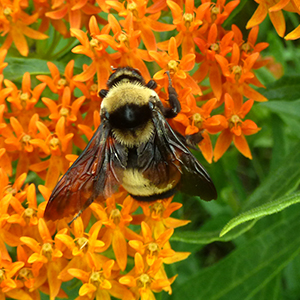
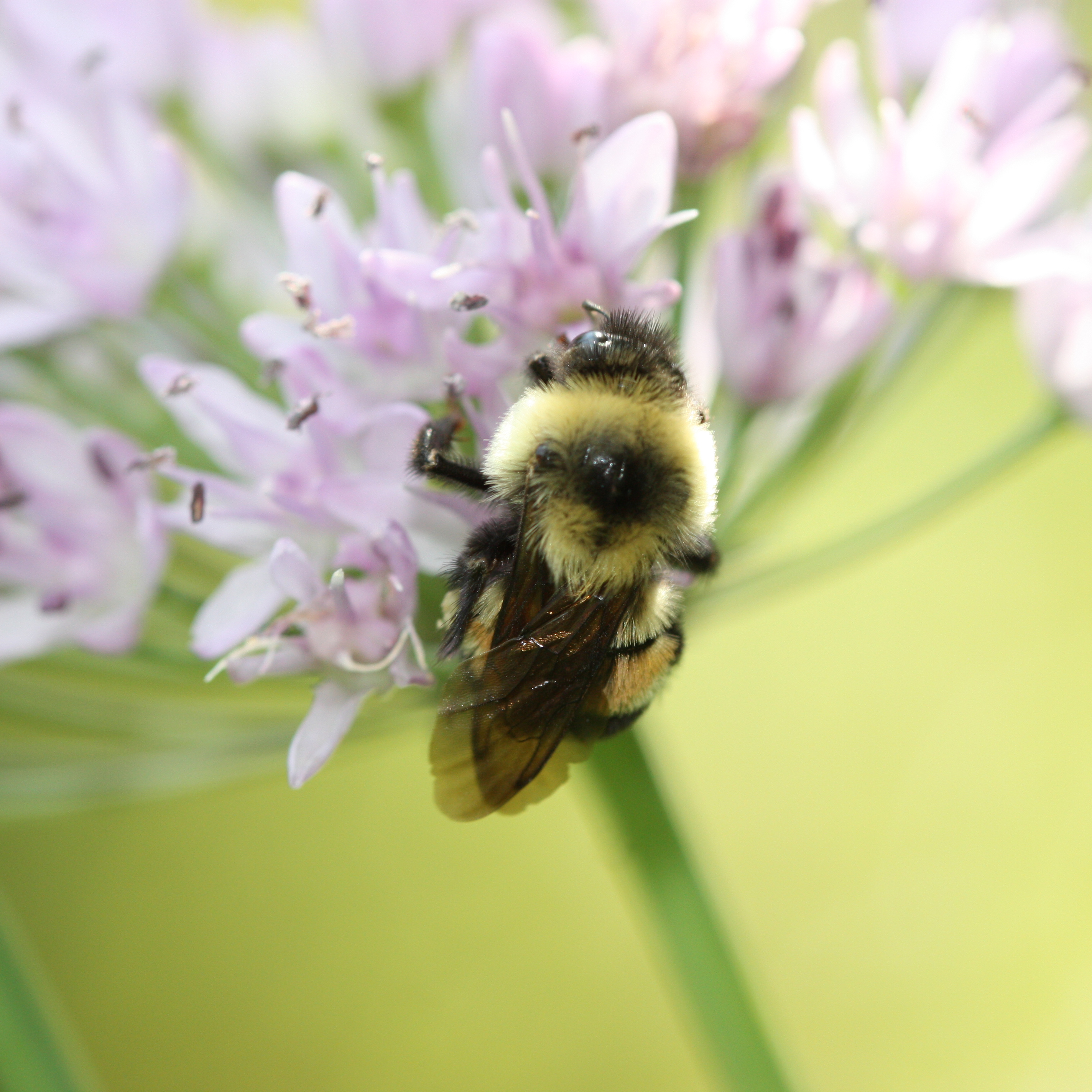
In the late 1990’s, bee biologists started to notice a decline in the abundance and distribution of several wild bumble bee species. Three of these species (western bumble bee, rusty patched bumble bee, and yellowbanded bumble bee) were once very common and important crop pollinators over their ranges. Franklin’s bumble bee was historically found only in a small area in southern Oregon and northern California, and it may now be extinct. The dramatic decline in wild populations of these species occurred about the time that a disease outbreak was reported in populations of commercially raised western bumble bees, which were distributed for greenhouse pollination in western North America. The timing of this suggests that an escaped exotic disease organism may be the cause of this widespread loss.
To better understand what happened, the Xerces Society worked with many scientists and citizen monitors throughout North America to develop a status review for three formerly common species of bumble bees: the western bumble bee (Bombus occidentalis), the rusty patched bumble bee (Bombus affinis) and the yellowbanded bumble bee (Bombus terricola).
There are a number of threats facing bumble bees, any of which may be leading to the decline of these species. The major threats to bumble bees include: spread of pests and diseases through commercial bumble bee rearing or other methods, habitat destruction or alteration, pesticides, invasive species, and climate change.
Commercial bumble bee rearing may be the greatest threat to B. affinis, B. occidentalis, B. terricola, and B. franklini. In North America, two bumble bee species have been commercially reared for pollination of greenhouse tomatoes and other crops: B. occidentalis and B. impatiens. Between 1992 and 1994, queens of B. occidentalis and B. impatiens were shipped to European rearing facilities, where colonies were produced then shipped back to the U.S. for commercial pollination. Bumble bee expert Robbin Thorp has hypothesized that these bumble bee colonies acquired a disease (probably a virulent strain of the microsporidian Nosema bombi) from a European bee that was in the same rearing facility, the buff-tailed bumble bee (Bombus terrestris). The North American bumble bees would have had no prior resistance to this pathogen. Dr. Thorp hypothesizes that the disease then spread to wild populations of B. occidentalis and B. franklini in the West (from exposure to infected populations of commercially reared B. occidentalis), and B. affinis and B. terricola in the East (from exposure to commercially reared B. impatiens). In the late 1990’s, biologists began to notice that B. affinis, B. occidentalis, B. terricola, and B. franklini were severely declining.
Where these bees were once very common, they were nearly impossible to find. B. impatiens has not shown a dramatic decline; Robbin Thorp hypothesizes that B. impatiens may serve as a carrier of an exotic strain of Nosema bombi, although it may not be as severly affected by the disease as B. affinis, B. occidentalis, B. terricola, and B. franklini. B. affinis, B. occidentalis, B. terricola, and B. franklini are closely related to each other (they all belong to the subgenus Bombus sensu stricto).
All bumble bees belong to the genus Bombus within the family Apidae. The family Apidae includes the well-known honey bees and bumble bees, as well as carpenter bees, cuckoo bees, digger bees, stingless bees, and orchid bees. B. affinis, B. terricola, B. occidentalis, and B. franklini all belong to the same sub-genus of Bombus, Bombus sensu stricto.
Bumble bees are important pollinators of wild flowering plants and crops. As generalist foragers, they do not depend on any one flower type. However, some plants do rely on bumble bees to achieve pollination. Loss of bumble bees can have far ranging ecological impacts due to their role as pollinators. In Britain and the Netherlands, where multiple bumble bee and other bee species have gone extinct, there is evidence of decline in the abundances of insect pollinated plants. Bumble bees are also excellent pollinators of many crops. Bumble bees are able to fly in cooler temperatures and lower light levels than many other bees, and they perform a behavior called “buzz pollination,” in which the bee grabs the pollen producing structure of the flower in her jaws and vibrates her wing musculature causing vibrations that dislodge pollen that would have otherwise remained trapped in the flower’s anthers. Some plants, including tomatoes, peppers, and cranberries, require buzz pollination. Read more.
If you have seen a bumble bee nest, please take a few minutes to fill out a survey about your observations. The results of this survey will increase our understanding of bumble bee nesting biology.
A number of scientists and citizen monitors have contributed their unpublished records of bumble bees or other information to this effort; we greatly appreciate their collaboration:
Bernd Heinrich, Professor Emeritus, University of Vermont
Chiho Kimoto and Sandy DeBano, Oregon State University, Hermiston Field Station
Chris Maier, Connecticut Agricultural Experiment Station
Christina North, University of Illinois
David W. Inouye, University of Maryland
Dale Reimer, retired
Doug Golick, University of Nebraska
Elaine Evans
Elizabeth Elle, Simon Fraser University
Howard Ginsburg, USGS Patuxent Wildlife Research Center
James Strange, USDA-ARS Logan-Bee Lab
Jennifer Grixti and Colin Favret, University of Illinois
Jodi DeLong, freelance writer
John Neff, Central Texas Melittological Institute
Kevin Alexander, Western State College of Colorado
Larry Stevens, Museum of Northern Arizona
Lee Solter, Illinois Natural History Survey
Liz Day
Matthew Bowser, Kenai National Wildlife Refuge
Michael Otterstatter, University of Toronto
Mike Quinn
Pete Schroeder, Southern Oregon University
Ralph Cartar, University of Calgary
Rebecca Irwin, Dartmouth College
Robbin Thorp, Professor Emeritus, U.C. Davis
Robert Jacobson
Robert Jean and Peter Scott, Indiana State University
Sheila Colla, graduate student of Laurence Packer, York University
Sam Droege, USGS Patuxtent Wildlife Research Center
Steve Hendrix and Chris Gienapp, University of Iowa
Sydney Cameron, University of Illinois
Sue Sheehan, Fermilab, Batavia, IL
T’ai Roulston, Research Associate Professor, University of Virginia