
June 16, 2026
50 Minutes
Guests: Ben Jantzen, Jackson Means
Tags: Special Guests,
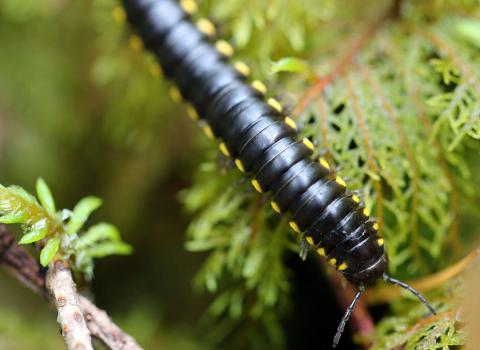
Millipedes. Do they really have a thousand feet? Listen in to find out!
Guest Information
Dr. Ben Jantzen is the founder and President of the Virginia Institute for Invertebrates. With a background in biophysics, especially insect flight, he is presently Associate Professor of Philosophy at Virginia Tech.
Dr. Jackson Means is an Assistant Curator of Recent Invertebrates at the Virginia Museum of Natural History and a myriapodologist (i.e., a scientist that studies millipedes, centipedes, and relatives). His research focuses on the discovery and description of new species, primarily in the mountains and foothills of Appalachia.
Show Notes & Links
In this episode we explain millipede taxonomy, key differences from centipedes, and wide variation in leg number. We discuss size extremes, global diversity, habitat needs tied to moisture, and crucial ecosystem roles in litter and wood decomposition and nutrient cycling. The conversation covers life history, longevity, chemical defenses, ant predators specialized on millipedes, misconceptions and occasional pest issues, potential impacts of invasives like earthworms, and the Virginia Institute for Invertebrates’ mission to monitor, conserve, and document invertebrate biodiversity, especially in Appalachia and Virginia caves.
Episode image credit: USFWS
Rachel: Welcome to Bug Banter with the Xerces Society, where we explore the world of invertebrates and discover how to help these extraordinary animals. If you want to support our work, go to xerces.org/give.
Matthew: Hi, I'm Matthew Shepherd in Portland, Oregon.
Rachel: And I'm Rachel Dunham in Missoula, Montana.
Matthew: Millipedes. Do they really have a thousand feet? To answer this and many other much more sensible questions, we are joined today by two people who know way more about these largely overlooked animals than I do, Drs. Ben Jantzen and Jackson Means.
Matthew: Ben is the founder and President of the Virginia Institute for Invertebrates. With a background in biophysics, especially insect flight, he is presently Associate Professor of Philosophy at Virginia Tech.
Matthew: Jackson is an Assistant Curator of Recent Invertebrates at the Virginia Museum of Natural History and a myriapodologist (i.e., a scientist that studies millipedes, centipedes, and their relatives). His research focuses on the discovery and description of new species, primarily in the mountains and foothills of Appalachia.
Matthew: Ben, Jackson—welcome to Bug Banter!
Ben: Thank you. I've listened to this podcast since it began.
Rachel: We're very happy to have you here today. And I'm personally excited because I know next to nothing about millipedes. So starting at the basics, can you tell us where they fit in with other invertebrates, taxonomically speaking?
Jackson: Yeah. Millipedes are in class Diplopoda, which means two feet, because they have two pairs of legs per body segment. And that class is part of—is one of four that are in Myriapoda. Myriapoda is made up of Diplopoda, Chilopoda, Pauropoda, and Symphyla. Chilopoda are centipedes, Diplopoda is millipedes. And then Symphyla and Pauropoda are two small groups that a lot of people are not very familiar with, but I recommend people looking them up because they are adorable. But these are a group of arthropods. So Arthropoda is the phylum that they belong to, and those are animals with a jointed exoskeleton. So think insects, crustaceans, horseshoe crabs, things like that, spiders. All of those are arthropods. So that's a really large group of animals. And millipedes fall into one of the two large groups within Arthropoda. There's the Mandibulata, which are animals with mandibles. So that's like insects and millipedes. And then there's the Chelicerata, which are the spiders, things that have chelicerae, which are these projections, these appendages in front of their mouths. So think of the pincers on a scorpion. So those are Chelicerata, and then there's Mandibulata. And millipedes and their relatives—Myriapoda—are sister to all of the other Mandibulata. So there's the insects, crustaceans, things like that. They're all in Pancrustacea. And then there's Myriapoda. That's a big answer, but I hope it's not too complex. But, yeah.
Rachel: No, it's helpful to visualize that and understand where they fall, because invertebrates are so diverse. So you did mention centipedes—that they are different from centipedes. I think people use them interchangeably. Maybe don't understand the difference between them—including myself, I'll be honest. I think it's the number of legs?
Jackson: So there's several differences. But there's two big ones. So the first one is, as you say, the number of legs. Diplopods have fused body segments, or body rings, and so their body rings have fused and therefore they have four legs, two pairs of legs per body segment. Centipedes—that didn't happen. So they just have one pair of legs per segment. And base—and then that kind of leads to the other big difference, which is that millipedes, with all those legs, they can't move very fast. They use all those short little—they’re relatively short—legs to push through leaf litter, and through soil, and debris. And so, they're kind of like a burrowing, pushing thing. And they are detritivores. They just eat leaves, and plant matter, and things like that. And so they're basically cows of the forest. They're very peaceful, slow-moving, little critters.
Jackson: And then centipedes are more like the wolves of the leaf litter world. They're fast. They are all predators. They have these big venom-delivering—forcipules, as they're called—these big venom-delivering jaws in front of their—like at the top of their face. And that is not—those are not chelicerae. Those are actually modified forelegs that then have these big venom glands. They can give you a nasty bite. And especially out West, you can get some really big ones that are dangerous. The ones of the East are—the biggest ones are just gonna give you like a hornet sting level, but it's still unpleasant. So if you uncover debris and you see something moving fast, leave it alone. If it's—if it curls up, or if it's just trundling along, it's probably fine to pick up.
Rachel: Okay, that's helpful. They almost sound endearing. I'm like, "Aw, the millipedes." Haha.
Jackson: They are endearing! Haha.
Rachel: So, this might be a stupid question, but do all millipedes have the same number of legs?
Jackson: No. It's not a stupid question at all. They vary wildly. I will say, you know, when they're first born, they are—they only have six legs, so we always joke that they're hexapods, which are—insects and relatives are hexapods. And but they quickly start adding segments. And the length really varies. Some of them are really long—have a lot of segments. Others only have 20 segments. And it usually—it's like some orders—. So there are 16 orders of millipedes, and in order to put that in context with like insects, beetles are a different order than wasps, right? So they can be pretty different. And so there are some millipedes that all the orders are really long and thin, and have lots of segments, lots of legs. Others, you know, they're all basically 19 to 20 segments with a few exceptions. So it really just depends on the, on the millipede.
Jackson: We actually found a few years ago, I was lucky enough to be on the team that described the first true millipede. So “milli” means 1,000 foot, and “centi”—centipede means 100 foot. And there are plenty of centipedes that have more than 100 feet. But there were not any millipedes that even approached 1,000 really. The leggiest was Illacme plenipes that was out in California, and it had 750 legs. But we found—. There was a group of researchers in Australia, and they were putting these traps baited with stinky cheese down the prospecting tubes that were left behind by people looking for gold along the coast, the edge of Australia. And they were putting these little traps down hundreds of feet into the earth, leaving them for a month, and seeing what creatures come, and then pulling them back out. And they found these millipedes that looked like little hairs, little white hairs. And they sent them to us. And sure enough, one of them had 1,306 legs. And some others had around 1,000—other individuals. And so that was the first true millipede. And it was totally blind. It was from about 220 feet down. It had a beak for a mouth, so it's probably eating cyanobacteria or something. And it was just very cool, crawling through the little crevices in the rocks. So that's the true millipede we now have. Eumillipes persephone. So Eumillipes means true millipede, and then Persephone for the legendary character.
Matthew: Yeah. Wow.
Rachel: I'm assuming there's variation in size. What's like the smallest millipede versus the largest?
Jackson: So there are some pincushion millipedes, which are really, really cool. They're the most ancient kind of group of millipedes. They are soft-bodied, and have bristles instead of armor, and they can be really, really tiny. They're adapted against ants. And the bristles gum up their jaws. They detach like a porcupine. And they can be only half a millimeter. There's a couple species, I think in Asia, that are a half a millimeter to two millimeters. There's another millipede species that maxes out about two millimeters. So I mean, these are really, really tiny. The head of a pin kinda thing.
Jackson: And then the biggest millipedes are the Archispirostreptus gigas which are in Africa. And Matthew may have encountered those guys or their relatives. There are a bunch of species out there that look like them. But they're like giant, brown or black sausages. And they can get—they're really cylindrical, you know, and smooth—and I think they can get a little over 15 inches. So pretty big. And they're really common in the pet trade because they're calm, and you can handle them, and they're not too bad. There are some species in Africa that produce chemical defenses that can make your skin slough off. So those are more dangerous, and they're big, too. But Archispirostreptus gigas is pretty chill.
Matthew: It was when I was in Kenya, we did have those big ones. I don't remember seeing any, not even as long as 12 inches, but six or eight inches were fairly common. And yeah, and you'd be able to pick them up and they'd climb up your arm. When my parents came visiting, it utterly freaked my mom out. And I said, "Oh look, do you want to see my millipede?"
Jackson: Haha.
Matthew: But yeah, they were harmless. Although, if you were too rough with them, they would exude some kind of chemical, and I'd—it never sloughed my skin off, but maybe I'm just not very sensitive.
Jackson: Yeah. It might be a time thing. That story of the sloughing was like a guy put one in his pocket years ago, and it soaked through his pocket onto his skin, and that skin, that patch of skin died. So it might just be like—.
Matthew: So the moral of the tale is don't get a giant millipede and put it in your pocket.
Ben: Here in Virginia, we do have Narceus. And a little bit further south, a species, a slightly larger species of Narceus. And even around here, these iron millipedes that are—they look, in form, similar to the giant ones, I believe you mentioned, Jackson. But they get maybe three, four inches long, and you'll see them crossing the roads is where you most often accidentally encounter them. It really seems laborious. It takes them quite a while. But it's like a living pencil making its way across the road. You could pick those up. I wouldn't put it in your pocket, or eat it, but they're amazingly relaxed for the most part. In fact, my daughter kept one as a pet for six years.
Matthew: I was gonna ask a kinda couple of follow-up questions. How many different species of millipedes are there—whether that's globally, or in this country, or maybe in your region? But also, can they be found anywhere? Are there any limits to where you might encounter a millipede?
Jackson: Yeah. So to your first question, there was a study years ago that showed there are about 12,000 species. We're probably approaching 13,000 at this point, because we describe species all the time. So yeah, I would say between 12 and 13,000 right now. But there's gonna be way more out there. That's just scratching the surface of the diversity, because they don't have a direct quantifiable or easily quantifiable economic impact, and so there's not a lot of, you know, funding to study these things. They don't vector diseases, they don't eat living plants, they're not a problem. And so, they're really understudied. So there's a lot of species out there that have not been described.
Jackson: And they live pretty much everywhere that most arthropods are found. So that's basically everywhere except Antarctica. Everywhere except the poles, where it's really cold. But you can find them in all sorts of different habitats. They do prefer—. So, millipedes—this is gonna get a little in the weeds—pun intended—but millipedes lack a waxy epicuticle. So that's on the outside of their body. They don't have a layer of wax that insects have. And that layer of wax helps insects regulate their body moisture. And because millipedes don't have that, they dry out really quickly. And so they do prefer to be in moist, wet, you know, gullies, and more cool, wet habitats. However, there are a lot of desert-adapted ones. And there are some that are desert-adapted that have developed a waxy epicuticle. So there's always exceptions to every rule. But they live pretty much everywhere, and especially in wet areas.
Ben: Jackson mentioned that they're understudied because they're not a problem. But loss of millipedes is a problem. They process an enormous amount of forest floor litter. And taking millipedes out of the picture in an ecosystem is a huge disturbance. So there's sort of a tension there.
Jackson: Yeah, and that brings up a good segue to something else interesting is that, they're not only removing leaf litter, but they are also, like Narceus, that Ben mentioned, are first responders when a tree falls down. They are big, and they have fairly, heavy rasping mouth parts, and so they can break down woody material. And allow that wood to become available to all sorts of different creatures, including even, fungus and bacteria, to get into. And they burrow in and everything. So they're like first responders, some of the millipedes. And then there are other millipedes that only eat the already partially broken-down stuff. So they're like extremely important for nutrient recycling.
Matthew: Of course, now I have this image of the first responders, like arriving with a little—.
Jackson: Haha.
Matthew: —blue light twirling on their head or something.
Jackson: Dropping from the trees above. Haha.
Matthew: Haha.
Rachel: All right, we're gonna dive in to talk a little bit more about their life history. So some basics. What do millipedes eat?
Jackson: So yeah, they eat mainly leaf litter. There have been a couple reports of them eating pig carcasses. That's because they've been found under carcasses, and stuff. But it's probably they're just attracted to the liquids that have been released and are not actually munching down on the body, but it's not 100% known. There is actually a millipede, now that I'm thinking about it, that I believe, has been documented to eat its young, in Africa. But I don't remember much about that. But for the vast majority of them, they are plant feeders. As I was saying, all sorts of different types of plant material. Broad-leaved trees are where you find a lot of millipedes—not all of them, you know—but pine needles are really acidic, and so they're not as into pine. But you can certainly find them up in pine forests.
Ben: And if I could give a little bit of scope. Imagine a 10-gallon fish tank, like a typical, tabletop fish tank, 10-gallon tank. One Narceus. Half-fill that tank with broad leaves, like Jackson was just mentioning, mostly maple, say. They like them when they're just starting to kinda rot, so not fresh, not super dry and crispy, but just starting to rot. So you've got half of a 10-gallon tank full of leaves. We would watch the one Narceus eat that entire tank. You can watch the level of the leaves go down over the span of month and a half, and then start all over again. So this is how much material these millipedes are processing.
Matthew: That's like a gallon a week.
Jackson: I can't remember the stat now, off the top of my head, but somebody did an analysis of how much a Narceus breaks down. And it is, it's a huge amount of leaf litter. So they are like really important. And all millipedes are important to the ecosystem.
Rachel: I have a follow-up question. What happens when there's no leaves around? Do the millipedes just not eat for a while? I'm just thinking seasonality. Okay, the fall. There's tons of leaves, and probably lasting through maybe the early summer. But is there a time where they choose another food item?
Jackson: That's a good question. There was a choice study with Apheloria virginiensis, which is the cherry millipede that's out East all over the place. And they did a choice with different types of leaves. But in terms of switching diets, I don't know that anybody's done that study. I will say that for part of their lifespan, they like overwinter underground for the most part. So when there's a paucity of food, or it's too cold for most of them, you know, or whatever reason, they will burrow underground. Sometimes fairly deep. We've found them like 18 centimeters underground, and sometimes even deeper. Actually, we found, yeah, we found some that are really deep. The ones that live in caves can be really deep.
Rachel: Earlier you said that there was one type of millipede that maybe eats their young, and I was like, "This conversation's taking a turn." Haha. But I'm gonna circle back to that part of their life history. Where do they lay their eggs? How many eggs do they lay? What do the babies look like? Can you give us a little bit of information about that?
Jackson: Yeah. Yeah. So these guys don't go through metamorphosis like some insects. They basically look like little millipedes when they're born. They're very cute, very adorable. And as I said, they only have six legs when they're first born, so they're just little tiny dudes. And they will keep adding more segments as they go. The way to tell an immature is that, you know, if it doesn't have reproductive structures, or if the number of segments is too low for what you know to be an adult—what the maximum length is for that group. But where they lay them is gonna be underground, in leaf litter, all sorts of other wet, moist areas. It really depends on the species, again. As far as we know. So this actually gets to what Dr. Cushing was saying about Solifugae in that episode, is that, you know, there's a lot we don't know about these animals because we're still just describing new species and giving them names. For example—and this is not to, you know, humble brag—but I've described just over 70 species or so. And I've only been doing this for about a little over 10 years now. And a lot of those were from Virginia. The vast majority are from the state I was in, you know? And we found a new species on Virginia Tech's campus on this really disturbed area. So there are, there's just so many species, and there's so little we know.
Jackson: And so where specifically things lay their eggs, we don't always know. Narceus lays its eggs in rotten logs. And you can find those, actually, if you're in Appalachia, and you break open a log. And there are hundreds of little, brown marbles, I'll call them, little, brown balls rolling down that are covered in what looks like dirt. That is actually feces. Narceus will lay her eggs—. They have what are called cyphopods up on their neck, you could call it, and the eggs come out there. They move the eggs all the way down their body with their legs, and then insert them into their anus, and coat them in poop, and then lay them out in a big old pile. And so that when they hatch, they eat that poop, and that's how they get the gut microbiome to be able to break down plant material. And it's very beautiful.
Matthew: That's just an amazing. And not only is the cycle amazing, but I love the fact that somebody worked it out, too.
Jackson: Yeah.
Matthew: And no, instead of marbles, I'm actually picturing boba, those—.
Jackson: Yes! Actually, yes. That is a better—that's an apt—because they're more like the size of—.
Matthew: Sorry, Rachel, I just wrecked your next boba drink, didn't I?
Jackson: Yeah, if one of those bobas is a little too like chewy. Haha.
Rachel: I think you wrecked it for everybody, Matthew. I'm not gonna get bubble tea for a while. Haha.
Jackson: I'm gonna call them millipede boba from now on.
Matthew: I had my mark on science finally.
Jackson: There you go. Haha.
Rachel: Very unexpected answer for life history facts of millipedes. But that I will not forget, and I will share with other people. Haha.
Jackson: There you go. That's the idea.
Rachel: And congratulations on identifying for the first time over 70 species.
Jackson: Thank you.
Rachel: That's incredible. It still blows my mind, because we've had other folks on that have said similar things of they're still finding different species of moths, and so on, and it's wild. I come from more of a vertebrate biology background. And it's not like you'd be like, "Oh, we found a new species of bear or eagle." That's just not a common occurrence. So yeah, it's really amazing. And that most of them were in Virginia, so it just gives you an idea of like how many different species of millipedes are out there that no one has ever described.
Jackson: Yeah.
Rachel: So calling to younger generations, if you want to study millipedes, you could find some and describe some that have never been discovered before.
Jackson: Yeah, that's what we always tell people is that it's a wide-open field in terms of discovery. And just to explain a little bit why—other than just the fact that we haven't worked on them—the reason that there are a lot of species is that, you know, they're flightless, a lot of them are blind, the largest order is blind. And, as far as we can tell, we're not really sure they like communicate with chemical communication. I'm sure they do on some level, but for the most part, they seem to just bump into each other and mate. And that's like how it works—they try to mate with pretty much any millipede, like anything that's basically their size, or that looks like them, or feels like them, I guess. And so they get stuck—. And again, the waxy epicuticle thing. So they get—they need to be moist—so they get stuck in these gullies, and these wet spots, and they don't move. They don't leave. It's very rare for them to disperse that much—at least, some species. And so they speciate over millennia. They get stuck in these areas and they just diversify. And so there's a lot of—. Like every gully you go into in Virginia, [you] might find a different species.
Ben: The Appalachians, in particular, are a real hotspot for this reason. Right, Jackson?
Jackson: Yes. Yeah, the Appalachians are a hotspot of diversity for millipedes outside of the tropics. So it's like the tropics and Appalachia are the big hotspots. And the reason that Appalachia is a hotspot is because during the last glacial maximum, the glaciers were not down in Appalachia. It was kind of a refugia for a lot of species to hide out. And then when the glaciers retreated, you get a lot of these species that are really widespread, going up into Canada, New York, or something like that, or out West. And that's because they were, for whatever reason, the first ones to start spreading as the glaciers retreated. And so there's not as much diversity at all when you get out into those areas.
Rachel: Oh, that's so interesting. So how long do they live?
Jackson: It varies. So as Ben said, he had a Narceus for six years. But like, Archispirostreptus may live eight to 10 years for all I know. Most of the millipedes I study—so like Nannaria, we think—again, we think—based on when we've had them in lab and stuff, and just from collecting them, we haven't done, you know, mark-recapture studies to see—but it seems like males live maybe a year and females live two years. Have a couple overwintering periods. They have several broods. It seems that the males, a lot of the males hatch in early spring, and then mate with the females, and then for summer, go underground again. Come up in fall, mate again, and then die. And so the big time to find a lot of the millipedes that I study are spring—early spring—and fall when it's cold. So yeah, it just depends on the species of how long they live.
Rachel: And then what do they do for self-defense? I know you mentioned if you're in your garden and you dig up some soil and you see something like roll up that's probably a millipede.
Jackson: Yeah, so defense is where millipedes shine. They've got a lot of cool defenses. The two biggest ones that people notice are, first, volvation, which is the rolling up. Volvation is the fancy science word for it. But rolling up in a ball to protect itself. There are some millipedes [that] do this better than others. So some don't roll up at all. Some kinda curl up a little. Others curl up into a perfect sphere and actually have a locking device so that you cannot open them. So there's a group of millipedes, they're called the pill millipedes. And the giant pill millipedes that live in—we've got, actually got a few here of the tiny ones—but the giant pill millipedes live in the tropics, especially Asia. And they can lock completely up. And they can be the size of like a large golf ball. You know, a pretty good-sized creature when it's rolled up. And there's a mongoose in Africa—or maybe Madagascar, I think it's Africa—that has learned to pick up the millipedes and slam them between its legs into rocks to crack them open. Because you can't pry them open. So rolling up is really good.
Jackson: Of course, they're armored. They’ve got these big, thick armor, so that goes hand-in-hand with the rolling up. But then the other big defense is chemical. So almost all millipedes—not all of them, but almost all millipedes—produce some sort of chemical defense. And some of those defenses can be really nasty. So the ones that I study out here in Appalachia, and what we have out West as well, are the big, pretty what are called mimic millipedes, or cherry millipedes. They actually have these bright colors. And they create mimicry rings because they all produce hydrogen cyanide. And one Apheloria virginiensis, which is our big cherry millipede, produces enough cyanide to kill 18 pigeon-sized birds. Now that would be if they released all at once, but they are pretty toxic, right?
Jackson: So there's cyanide, but then all the other groups produce all sorts of different chemical defenses. There's one group called the slug millipedes that are really cute, and they produce what smells like Vicks VapoRub, which is really nice. But the cyanide-producing ones smell like cherries. They smell like a cherry cola. They're actually quite pleasant to smell, but we try to blow away—cyanide is odorless, so it's a gas—so you blow it away, and then you can enjoy the smells of the benzaldehydes.
Jackson: But! That brings me—I know this is a long answer—but that brings me to a cool story. So there is an ant species. The Poneracantha ingeborgae. It's a really weird name. But it's a person's name that they named it after. But it's an ant species that that entire genus, or most of them, specialize on millipedes. And that ingeborgae—. There was a guy, a researcher, who took a colony of them from Columbia. Brought them to New York where he was studying, and had them in his lab. And he put Oxidus gracilis in with them, which is an invasive millipede that we have here that's called the greenhouse millipede. Because they come into greenhouse plants. And you might have some in your room behind you. They are like little brown strings of beads, is what they look like.
Jackson: And these ants—. So when presented with them, the ant will come up and she will quickly mount onto the back of the millipede, and bite it behind the neck, and sting it between the segments. And it injects a paralyzing toxin. It then jumps off and pretty much leaves for like 15, 20 minutes. We think—it also cleans itself—we think to allow the cyanide to disperse. And then it comes back, and it flips it on its back, grabs the neck like right here on the millipede, and throws it over its back like a sack of potatoes. And then it drags it back to the nest, and throws it down—it goes down into the nest—and throws it down into larval chambers where they have larvae. I think it's like first and second instar larvae. And then it snips off the neck by—it bites, and it uses its abdomen, the stinger, basically, as a pivot or something, to push between the segments and snap the head off. And then the larvae start to eat into the body of the millipede. And as they finish segments, it'll snap like that, like a bottle opener, snap off each segment as it goes down, and the larvae eat it.
Jackson: And it won't—it will not do that to other millipedes. So other millipedes that produce different chemicals that are not cyanide, it's like a frantic attack. It's not like a methodical, practiced thing. It's like this—. They like freak out, and they get sick. They seem sick and things. So they seem to have some tolerance to cyanide. And on top of that, there are anecdotal evidence that they smell when disturbed—these ants smell also like cherry cola. And so there's a good chance that they might be sequestering the toxins for themselves. How they do that, we do not know. This is a 1993 publication that Brown came out with, who's a big ant guy. I highly recommend you look up “1993 Brown.” And the genus is Poneracantha ingeborgae. But you can find it online. It's just one of those really cool stories that I just love. And it's—. See, the only reason we know about that is because this was an ant person, and we know a lot about ant ecology. And we don't know much about millipede ecology. So that would be a cool study to see if they actually do sequester the cyanide, and how. But there you go.
Matthew: I'm just like—. Wow. And I was thinking—again, the way my head goes—I'm like, "Oh, it seems a bit like a baguette breaking up," when it—.
Jackson: Yes. Yep. Haha.
Matthew: Because that's what we used to do when we had picnics with our—when our kids were younger. We'd go to the store. We'd buy the long French bread, and then we'd break it up and give it to them. Do you know what I mean?
Jackson: Throw it over the back and drag.
Matthew: I didn't actually do—. No, we just used to carry it in a basket. That's one reason I love working with insects and invertebrates. There's just these endless fascinating life history stories that come out. Yeah, amazing!
Jackson: This is just the pin millipede, the pincushion millipedes I've mentioned earlier that are covered in these urticating hairs, basically like a tarantula. There's a group of ants, another group of ants—. And this is how I eventually found out about Poneracantha. I was looking up Thaumatomyrmex, or we call them tomato myrmex, but it's Thaumatomyrmex. They have these antler-like jaws, and they actually use those to scrape the setae off. They are, they only eat bristly millipedes. That's all they eat. And they actually comb off all of the hairs and bring back the poor nude millipede to the hive. And I met an ant guy. I won't call him out because this is not published, so this is just his—what he told us in Costa Rica in 2014. We ran into him at the Museum of Natural History in Costa Rica, and he claimed—he was studying ants—and he claimed that he had seen the ants then use those bristles as a palisade in front of the entrance of their nest. So they put them in the ground, sticking out in front of their nest to help protect them against predators. He hadn't published it, so I can't say that that's true, but man, I want that to be true. Haha.
Matthew: Wow. Yeah, my next question was gonna be what role do millipedes play in our environment? And so I'm now like, “Okay, so they're prey.” We know that they're detritivores. And now they can be used as defensive. Haha. What don't they do?
Jackson: They don't attack other people, or other animals, so they're super chill. But yeah, no, they're pretty cool. I mean—. So they are one of the oldest groups. They're the first—we think. It's either a centipede or a millipede—but we're pretty sure millipedes are the first oxygen-breathing land animals. They're the first to have chemical defenses. They're the first to have external genitalia. They're like 450 million years old or so. We have fossils from 430-some, and they're like fully formed. Like their body layout is exactly as it is now. So it's like, they have to be older than those fossils. They've been around for a long time. So they play a really important role in ecology because they've been here forever.
Matthew: Yeah. No, when you talk about fossils—your job title is “recent invertebrates.” So that gives a kind of context for your job.
Jackson: Yeah, it's basically any specimen that hasn't yet turned to rock.
Matthew: That's a pretty solid threshold, isn't it?
Jackson: Haha. Yeah.
Matthew: Like, knock it on the table and, "No, I can't do that one." You know? When I was reading about millipedes to kinda get my head into this episode, I kept finding adverts offering ways to get rid of them. Do you think there's much disinformation out there about millipedes? Or like widespread opinions that are misleading?
Jackson: Yeah. I think that gets to what Rachel was saying earlier, which is that a lot of people don't know the difference between millipedes and centipedes. You know, I confess, I grew up playing with insects and everything as a kid, but I didn't really mess with millipedes or centipedes. And it wasn't until I got into grad school that I started to learn the big differences between them, other than just kinda like anecdotal stuff. So yeah, I think a lot of people, as Rachel said, also, they got a lot of legs, and that can be disconcerting for people. And all the creepy crawlies are gonna freak people out if they don't know about them. And the more you know about it, the less worried you'll be. But yeah, unfortunately a lot of people wanna get rid of millipedes.
Jackson: I will say, you know, there are some reasons to get rid of some millipedes. So that one I mentioned that was attacked by the ant, Oxidus gracilis, which is the greenhouse millipede, they are attracted to water, like a lot of millipedes are, but they seem—. One reason they are—they're now, like almost ubiquitous everywhere. They've been spreading out. And one reason may be that they can actually walk along the bottom of streams underwater. And they seem to maybe capture bubbles, like aquatic beetles do. They have bubbles on them, and they can survive underwater for a while. And so I had a friend that actually had a big aquarium, a really beautiful aquarium in his basement. And there was a swarm, for whatever reason, of Oxidus. And he came in, and there were a ton of them just in the aquarium. And they produce hydrogen cyanide, and all of his fish were dead. And so that was a big bummer. They might kill your fish apparently, but they're not a big pest. But yeah, there's a lot of misinformation out there.
Matthew: I think you can probably say that about many different invertebrates one way and another. From what we know about millipedes, are there any species in decline? You were saying that a lot—. You're still identifying species, so maybe we're still at the identifying stage and not the population status stage.
Jackson: Yeah. Basically. It's a really good question. It's something I would love to know. I will say—again, yeah, so we haven't really done any big studies on millipede population decline—I will say that they're anecdotally—. Again, when I started this in—I started millipedes in 2014, and I would go out and find Oxidus occasionally—Oxidus gracilis. And as the years went on, I would find them in larger and larger numbers. And I would find less or fewer and fewer of the millipedes that I was trying to find.
Jackson: And another thing that I think is more impactful than Oxidus—because we don't know. Oxidus is probably competing for resources—but the big problem was invasive earthworms. So earthworms that people had brought in for fishing. They really degrade the soil into this dry, nutrient-free, crumbly crap. Haha. Literally. That's got no moisture or anything. And the leaf litter's always really thin where you find a lot of those earthworms. And you just don't find—you find Oxidus and other invasive millipedes, but not—or, I should say introduced millipedes. There's a difference between introduced and invasive—but introduced millipedes. But not really the native ones you're looking for. So there certainly might be an increase. I would say there's probably an increase in some species' numbers and a decrease in others, but we have not yet quantified that.
Rachel: Yeah, if you haven't identified all of them, it's hard to know what their populations are, right?
Jackson: Yep, absolutely.
Rachel: So we would be remiss if we didn't mention that you both work with the Virginia Institute for Invertebrates. Can you tell us a little bit about this? And I think also why are we talking about millipedes? You know, you guys talked about them being these decomposers, and they're important for soil health, and they're really species that we should be trying to save. And I think I have a gander that that's what you're trying to do at the institute. So yeah, I'd just like to hear a little bit about it. And what your purpose is, and what you're doing.
Ben: Yeah, I'd love to take that question. So the Virginia Institute for Invertebrates is a very new nonprofit dedicated to monitoring, conserving, and witnessing the invertebrate life of Virginia. When I say monitoring, what I have in mind really goes to Matthew's question about decline. So, you know, when people talk about global decline of insects—. This was really pushed into the public consciousness in 2017 with a German study that showed an astonishing loss of three-quarters of the flying biomass over a series of preserves in Germany over a span of time around 25 years. And when that happened, researchers scrambled to answer questions like Matthew was asking about other taxa. So which groups of insects? What about other invertebrates? Does this pattern show up globally anywhere we look? Is it worse in some places and better [in] others? What's the picture? And people quickly realized that we don't have other data like the German data. No one has been sampling populations of invertebrates—insects or otherwise—over long periods of time with a standardized methodology that could answer these questions. The natural variation year to year in invertebrate populations, particularly insects, is so huge, that to see a trend even as giant as a three-quarters loss of biomass requires measurements over tens of years.
Ben: And the institute—this is where we come in. So we're establishing, at least in the Commonwealth of Virginia, a series of monitoring sites under our control, such that these kinds of observations can be made in the same way over sufficient time to disentangle these questions about loss. And to include in those observations groups that, like the millipedes, that are usually left out of those kinds of studies.
Ben: When I talk about conservation, of course, we're interested in staunching the loss in both abundance and biodiversity, given the critical roles invertebrates play in every ecosystem, in both respects. And so there we look to protect and connect remaining patches of quality habitat.
Ben: And finally, with respect to witnessing, what I really mean is natural history. So this includes supporting the kinds of prospecting that it takes to identify species. And as Jackson said, there are lots of just millipedes still unknown in the state of Virginia. The part of the United States that has been studied the longest by trained naturalists, since at least the early 17th century still is full of unknown species. We don't know what diversity is even there to begin with. But by natural history, I also mean the kind of open-ended work that leads to the illumination of stories like the wonderful ones Jackson's been telling us about ants assaulting millipedes, and millipede life cycles. That kind of work, untangling just a life cycle of one species, involves a great deal of patience, observation, and uncertain effort in the field. And that is something we very much want to support. And there isn't a lot of institutional funding in the sciences for that kind of work. And yet it's the sort of critical beginning of the pipeline for biological inquiry overall.
Ben: As to why millipedes, in particular. I mean, a very big reason is, as we've already mentioned, Virginia, the spine of the Appalachians run down the Commonwealth of Virginia. And we are a hotspot for millipede diversity. They make up not just an ecologically essential component, but a huge and diverse group with respect to our emphasis on natural history. But of course it's not just millipedes. It's not just insects. There are freshwater—. Virginia's kind of an upside-down Galapagos Islands because we're a karst geology. So there are these cave systems that are effectively isolated from one another, similar to islands on the ocean. And so we have all kinds of endemic freshwater organisms, amphipods, and isopods. Near the surface, we have endemic invertebrates, various crayfish species. All of these are in the remit of what we're trying to do with the institute.
Rachel: That was beautifully said. Thank you for explaining all that, and all the work that you do. It is really important.
Ben: Happy to share with your audience.
Matthew: Yeah. No, that's great. It's fascinating. I didn't realize that Virginia was a karst landscape. Intrigues me because when I was in Britain working on limestone and chalk landscapes, and at college studying karst land forms. And so I was like, "Oh, wow, Virginia has that?"
Ben: There's a great deal of geological affinity, actually. Some of the myriapod fossils Jackson was mentioning, so Devonian fossils. The sort of the type stratum is in England for the Devonian. But the equivalent layer is exposed just outside my window—I can see the hill. And so we share a lot of that geological, and in this case, myriapod fossil heritage.
Matthew: Wow.
Jackson: Yeah, there's actually over 4,000 caves in Virginia. And I am working on a revision of Pseudotremia, which is a genus that can be found in pretty much every cave, including the one that we have on a preserve that we're getting, called Spineless Cave Preserve. We have Pseudotremia in there. And yeah, they're isolated, and they become distinct species. They have longer legs. A lot of them lose pigment, and they have reduced number of eyes. These are not the blind ones—it's a different group. Yeah, there's actually—. When we're done with that revision and some other groups that we're studying, we should have a little over 200 species of millipede in Virginia. Which is pretty good.
Matthew: Yeah. No, that's excellent.
Ben: As a sign of the work yet to be done on that very preserve, or what will be the Spineless Cave Preserve that Jackson just mentioned, when he and I were out there investigating the land for its potential as a preserve, we came back with a new species of Nannaria. Just to give an idea of how much is not known in Virginia.
Jackson: Yeah, and this was three miles from the type locality of another species. And type locality is where a species is described from. And so three miles is not very far. And so I expected the species to be that first, already described species, but it's totally different.
Matthew: Yeah. There's always something new to be discovered, isn't there?
Jackson: Yep.
Matthew: Yeah, that's great. Thank you so much. I've had so much fun. And learnt so much about millipedes, even like the basic, fundamental stuff. And also those really cool stories you were sharing. And this is getting greatly nerdy, which is wonderful, so thank you for that. We just want to wrap up with our kind of two regular questions for people. The first one is: what inspired you to get involved with invertebrates?
Jackson: I'm an only child, and I grew up in the woods of Virginia with no really neighbors around. We had, my parents had about 60 acres in the forest near Charlottesville, so in Albemarle County, Virginia. And I played with bugs, just all the time. And there were just tons of different—ants, especially, caterpillars, and all sorts of things. And so I got really into insects that way. And then I kinda continued with a naturalist bent all through high school. I made a greenhouse for my high school as my senior project, and went on to be environmental studies. And so I was always into creepy crawlies. But it was really when I worked at the Center for Historic Plants at Monticello. We had a huge variety of plants. And the assassin bugs on those plants were amazing. If anybody's unfamiliar with assassin bugs, look them up. The nymphs, which are the young ones, are wildly different colors and everything. They're just bizarre-looking. And that, I was like, "I need to go to grad school, and entomology would be a good choice." So yeah, it was kind of a lifelong passion.
Ben: When folks ask me that question, it's usually with a little extra confusion, because I am a professor of philosophy at Virginia Tech, and they want to know why I have anything at all to do with invertebrates. And I will say that first as a biophysicist and then as a philosopher of biology, I've spent a lifetime thinking about the nature of living things. And I've come to realize two things. If you want to begin to disentangle some of the big questions of biology, questions like: how small can a living thing be? How complex can a food web be? How much diversity can an ecosystem sustain? How fast can evolution produce it? Any of these sorts of questions that are at the core of biological inquiry. If that's what you wanna know, you have to pay attention to the invertebrates. The most speciose and morphologically diverse group of multicellular life that there is. And the second thing is that if you care about biodiversity and abundance in their own right, then you have to care about invertebrate conservation. That's how I wound up here.
Matthew: Yeah. Thank you. Because I was kind of intrigued by that. To me, the idea of thinking about biology, that's not what you think philosophy is, as someone on the outside. In the same way that someone on the outside of invertebrates may not really know what invertebrates are. It's like my own knowledge of philosophy is so lacking. And I also loved your answer because it's almost like, that's exactly what Xerces Society is all about. We are here, we're thinking a lot about invertebrates, and dealing with it, because how can you do conservation without invertebrates?
Ben: Absolutely.
Matthew: Yeah.
Rachel: Yeah, I was gonna say that, too. Ben, I just appreciate your perspective. Because I'm like, “You get it.” You understand the gravity of how important invertebrates are. And so I'm just grateful for what you're doing in Virginia. And yeah, it's just been great to have you both on. And I've learned a ton. And I'm really intrigued as to what your answer will be to my question. Haha. Which is: if you could see any bug or invertebrate in the wild, what would it be and why?
Jackson: Oh, if you don't mind me taking it first. So I mentioned earlier the pill millipedes that lock in a perfect sphere. I think a really cool critter—. And I thought this was funny because Dr. Cushing's answer was a thing in Madagascar. These guys are also in Madagascar. They are arboreal, giant, green pill millipedes, and they are—it's like a small baseball. And they live in the trees in apparently fairly good numbers. And that would be awesome to see those. And pick them up, and have them curl up and lock their little helmets. And they're just, they're like so adorable. And just bizarre. Why are they in the tree? And they're like huge. And, I assume, heavy. It seems like a foolish choice. But yeah, that—I think the giant, arboreal pill millipedes of Madagascar.
Ben: That's—. Boy, that's a great answer. My answer would change if you asked me again tomorrow. I'm tempted to say a velvet worm. They're so rare and awesome. I've never seen one. But I'm heading out West again this summer, and I'm hoping to find some more snakeflies. Because snakeflies are a strange and wonderful order of primitive full metamorphosis. And any insect that has a predatory pupa is just A-okay in my book.
Rachel: Oh, that's awesome. Thank you both so much. This has truly been a pleasure. I love these episodes. Information is power, I think. Jackson, that's what I just kept repeating in my mind as you were talking. Because you're like—all the misconceptions. We talk about millipedes, talk about solifuges with Dr. Cushing. We talked about flies with Dr. McAlister. And people just think "Ah, they’re just annoying bugs. I just don't want them around." But then once you actually learn about them, and their behaviors, and how cool and unique they are, you just fall in love with them. And now I just feel like I love millipedes.
Rachel: And I've definitely seen them curl up in my garden. And, you know, it's gardening season, it's springtime, we're gonna put our plants in the ground this weekend. And like now I'm like, "Oh, I'm gonna go for a hunt, try to find some millipedes.” And I'm excited about it! So I just—I love doing Bug Banter for this reason. Because the listeners now have a deeper understanding and hopefully an appreciation of these critters that we should care about. And hopefully talk to other people about how cool they are, which I know I'm gonna do this summer with my family. So thank you both for what you're doing. And for just—I've been smiling the whole time, and laughing a lot in this episode. The joy, and just your love of invertebrates, and the work that you're doing is so incredibly important. And thank you for just the time you took to be here with us today. It's been wonderful. So, thank you so much. We really appreciate it.
Jackson: It's a lot of fun. It's always fun to spread knowledge. All those things you see online like, “The one thing scientists don't want you to know.” It's like there is nothing scientists don't want you to know. Haha.
Rachel: Haha.
Jackson: That's—It’s a really silly, silly concept. So, thank you for giving us the opportunity.
Matthew: Bug Banter is brought to you by the Xerces Society, a donor-supported nonprofit that is working to protect insects and other invertebrates—the life that sustains us.
Matthew: If you are already a donor, thank you so much. If you want to support our work, go to xerces.org/donate. For information about this podcast or for show notes, go to xerces.org/bugbanter.