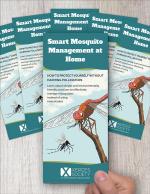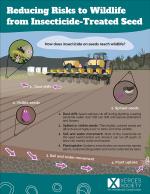
As a science-based organization, the Xerces Society produces dozens of publications annually, all of which employ the best available research to guide effective conservation efforts. Our publications range from guidelines for land managers, to brochures offering overviews of key concepts related to invertebrate conservation, from books about supporting pollinators in farmland, to region-specific plant lists. We hope that whatever you are seeking—whether it's guidance on making a home or community garden pollinator-friendly, advice on developing a local pesticide reduction strategy, or detailed information on restoring habitat—you will find it here!
Find Publications
Use the search functions to sort by publication type (books, guidelines, fact sheets, etc.), location, and/or subject (agriculture, gardens, pollinators, pesticides, etc.).
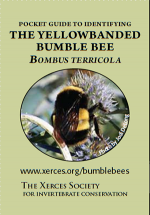
Bombus terricola - 2nd edition
By Elaine Evans and the Xerces Society
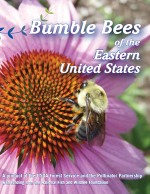
This U.S. Forest Service guide provides information to identify 21 bumble bee species found east of the Mississippi River.
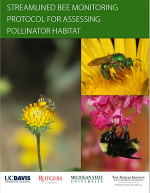
Developed the University of California, Davis, Rutgers University, Michigan State University, and The Xerces Society, this guide provides instructions for assessing pollinator habitat quality and diversity by monitoring native bees. It was developed for conservationists, farmers, land managers, and restoration professionals to document how native bee communities change through time in pollinator habitats. It includes an introduction to bee identification, a detailed monitoring protocol, and data sheets for different habitat types.

Habitat Installation Guide
These region-and state-specific guidelines provide in-depth practical guidance on how to install and maintain nectar- and pollen-rich habitat for pollinators in the form of wildflower meadow plantings/conservation cover (NRCS Conservation Practice 327) or linear rows of native flowering shrubs/hedgerow plantings (NRCS Conservation Practice 422). Seed mixes and plant recommendations for each region are included in the appendix of each guide.
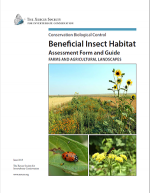
Beneficial Insect Habitat Assessment Guide
This beneficial insect habitat assessment guide is designed for a single site on a farm or agricultural landscape.
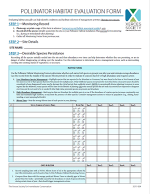
This form was designed to monitor wildflower diversity and longevity on a single site over time when used in conjunction with Maintaining Diverse Stands of Wildflowers Planted for Pollinators and the accompanying forms:
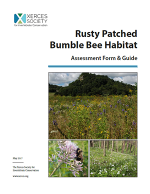
For Natural Areas on Private/Public Lands
This rusty patched bumble bee habitat assessment guide is designed for natural areas on public and private lands.
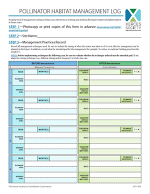
This form was designed to monitor wildflower diversity and longevity on a single site over time when used in conjunction with Maintaining Diverse Stands of Wildflowers Planted for Pollinators and the accompanying forms:
Developed by the Xerces Society for Invertebrate Conservation, with support from Oregon Tilth and the USDA’s Natural Resources Conservation Service, Bee Better Certified works with farmers and food companies to make places that are better for bees and other pollinators. This brochure serves as an informative introduction to the program.
Bee Better Certified® is the gold standard of pollinator-focused farm certification programs. Developed by the Xerces Society, the world’s largest science-based pollinator conservation organization, Bee Better Certified builds upon nearly two decades of on-farm habitat research and development.